12001 N MacArthur Blvd., Oklahoma City, OK 73162


Bringing Home a New Kitten in Oklahoma City
Bringing a new kitten into your family is one of the most exciting things a pet owner can experience, and at Warwick Animal Hospital, we want that experience to be just as reassuring as it is fun. Our team has served cat and dog owners throughout Oklahoma City for decades, and kitten wellness care is one of the areas we care about most.
Your kitten will need several visits during the first few months of life, and we encourage you to ask questions at every one of them. There is a lot to cover during this stage, so this guide walks through what to expect at each phase of kitten development, along with the vaccinations, testing and preventive care your kitten needs to thrive. Schedule your kitten's first visit with our team today.
Kitten Development Stages
Every kitten moves through a few key stages of growth during the first year, and knowing what to expect at each one helps you support healthy development from day one.
Newborn Kittens (0 to 4 Weeks)
During the first four weeks of life, kittens are developing their motor skills, coordination and ability to regulate body temperature. This is a delicate stage, and pet owners should watch closely for warning signs, including:
- Refusal to nurse or eat, especially in kittens separated from their mother
- Delayed or difficult motor skill development
- Lethargy, diarrhea or vomiting
A nursing mother should be feeding her kittens throughout this period. If a kitten has been separated from its mother, a commercial milk-replacer formula should be given every two to four hours. Around the four-week mark, milk replacer can be offered in a shallow dish to begin the weaning process, and a soft, easily chewable diet can be mixed into warm milk replacer four to six times a day.
Kittens at 5 to 8 Weeks: The Socialization Stage
Between five and eight weeks, kittens shift their focus to socialization, learning appropriate play and how to use a litter box. Enrichment matters a great deal at this age. Kittens raised in an understimulating environment are more likely to develop behavior problems later in life.
By this stage, kittens should be able to chew solid food and typically need three to four meals a day. Canned food is often recommended because it mimics a cat's natural diet, though a mix of canned and dry food can also work well.
Key milestones to work on during this stage include:
- Litter box training
- Regular petting, cuddling and handling
- Toy introduction and supervised exploration
- Positive reinforcement for good behavior
- Redirection away from biting or scratching
- Controlled introductions to new people and animals
- Weekly grooming and combing
If you notice fearful behavior, aggression or excessive play-biting, mention it at your kitten's appointment. These habits are far easier to address while your kitten is still young.
Older Kittens
After six months of age, kittens typically move to two to three meals a day and should be reliably using the litter box. A healthy older kitten is playful, curious and full of energy. Kittens reach adolescence around this time and should be spayed or neutered before six to eight months of age.
Kitten Vaccination Schedule
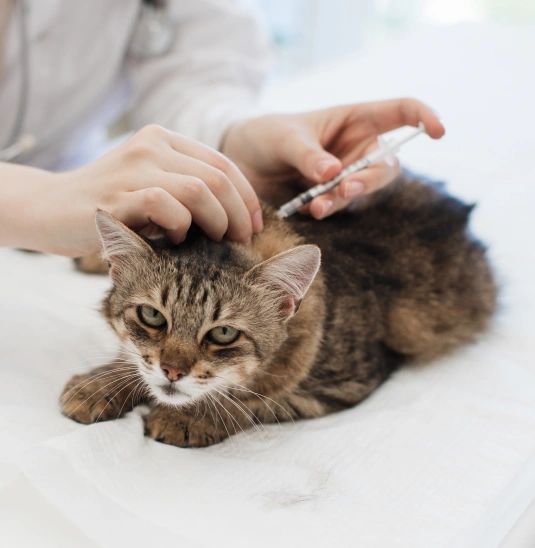
We generally begin vaccinations between six and eight weeks of age, with booster visits every three to four weeks until your kitten reaches sixteen weeks. Core vaccinations protect against:
- Panleukopenia virus
- Feline viral rhinotracheitis
- Calicivirus
- Rabies
- Feline leukemia
We also recommend testing every kitten for Feline Leukemia Virus and Feline Immunodeficiency Virus at first visit. You will receive a full breakdown of these diseases in a Kitten Care Kit at your kitten's first appointment. If you do not receive one, just ask a member of our team.
Deworming and Parasite Prevention
Kittens can pick up intestinal parasites from their surroundings, but many new owners are surprised to learn that roundworms and hookworms can also be passed from mother to kitten before birth. Because humans can be affected by exposure to immature roundworms and hookworms, we recommend deworming kittens multiple times between six and twelve weeks of age.
Heartworm disease in cats is often overlooked, and there is no fully reliable test for it in cats. For that reason, we recommend monthly heartworm prevention for every kitten, available in both topical and oral forms.
FeLV and FIV Testing
Feline Leukemia Virus and Feline Immunodeficiency Virus share similarities with HIV in humans, though neither virus can infect people and HIV cannot infect cats. Both can be passed from mother cats to kittens, and while neither disease is curable, early detection makes both far more manageable. We test every kitten for both viruses at the first visit.
Kittens who spend any time outdoors should be vaccinated against Feline Leukemia, which requires two initial injections three weeks apart, followed by yearly boosters. A vaccine for Feline Immunodeficiency Virus is also available and worth discussing for kittens with outdoor access.
External Parasite Control
Fleas, ticks and ear mites are the external parasites we see most often in kittens. We offer a range of safe, effective parasite control products suited to your kitten's age, including Revolution and Frontline for flea and tick prevention. Flea control can be confusing, so please ask our team any questions about the options available. We also offer treatment for ear mites when needed.
Spay and Neuter Surgery
Spaying or neutering is one of the most important steps you can take for your kitten's long-term health, and most kittens reach sexual maturity between six and eight months, making surgery before that window ideal.
For female kittens, spaying greatly reduces the risk of:
- Unwanted pregnancy and pet overpopulation
- Attraction of male cats during heat cycles
- Life-threatening uterine infections
- Mammary cancer
For male kittens, neutering greatly reduces the risk of:
- Aggression and dominance behavior
- Roaming, which contributes to pet overpopulation
- Territorial urine marking
Give Your Kitten the Right Start
From the first vaccination to spay or neuter surgery, our team is here to guide you through every stage of your kitten's first year. Schedule a kitten wellness visit at Warwick Animal Hospital and let us help your new companion grow into a healthy, happy cat.